Graphed.com's Spike-and-Crash: The Latest Receipt That Agent-Scaled SEO Rents Traffic
Graphed.com's organic traffic spiked, then crashed within weeks, per third-party estimates. What the agent-scaled SEO pattern means for Shopify stores.
Entities in this article
There’s a chart going around that every Shopify founder should sit with for a minute.
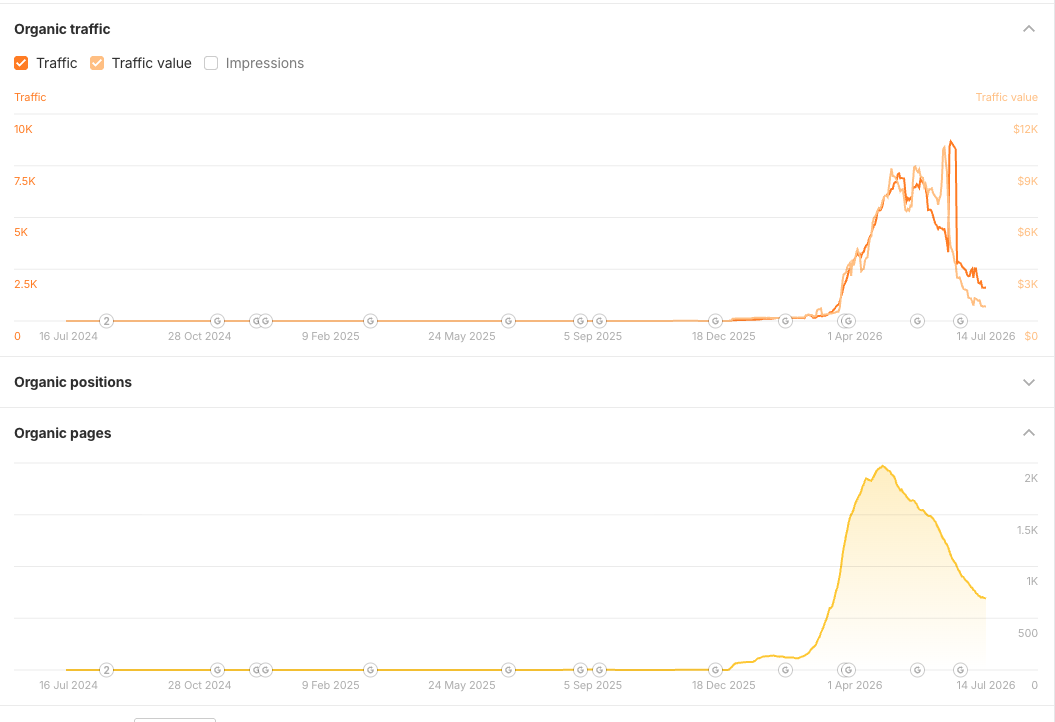
It’s a third-party organic-traffic estimate for graphed.com. Near-zero through November 2025. Then an almost vertical ramp from January through June 2026, peaking around 10,000 estimated daily organic visits, with an estimated traffic value near $12K/month. Then, within weeks, the line falls off a cliff — down to well under half of peak by mid-July. The organic-pages panel tells the same story in a different shape: a climb to roughly 2,000 ranking pages, then a steep decline.
Caveats first, because they matter. These are third-party estimates, not the company’s analytics. Tools like Ahrefs model traffic from rank positions and volume data; they can overstate the ramp and overstate the fall. Nobody outside the company knows the real numbers. Treat the chart as directional.
But directionally, this is a shape we’ve seen enough times now to name it.
What graphed.com is, and who built it
Graphed.com is Cody Schneider’s company. If you follow AI-marketing X, you know him — he previously built Swell AI and Drafthorse AI, and he’s one of the most consistent public advocates of using AI and agents to run SEO at scale. His programmatic SEO explainer is a good sample of the thesis: “programmatic SEO is when you build landing pages based on a template for every long tail keyword related to your brand and AI has made it easier than ever to make this.” Drafthorse’s pitch was even more direct: upload 100 target keywords, get 100 SEO-optimized articles minutes later.
Graphed itself launched mid-2025 as an AI analytics and dashboard generator, and today positions itself around deploying AI marketing agents — including agents that generate SEO content. Which makes its own domain about the cleanest public test of the thesis you could ask for: an AI-agent company, run by a genuinely sharp growth operator, doing agent-scaled SEO on its own site.
And let’s be clear about the first half of the chart: the strategy worked. Zero to an estimated ~10K daily organic visits in about six months, on the back of roughly 2,000 pages, is real execution. Most SaaS companies never see a ramp like that from content, with or without AI. Whatever you think of the method, the spike was earned.
The question was never whether agent-scaled content can produce traffic. It obviously can. The question is whether you get to keep it.
What the second half of the chart looks like
We don’t know what caused graphed.com’s decline. The company hasn’t commented publicly on it as far as we can find, and again — estimates, not analytics. What we can say is that the timing lines up with a specific, well-documented event: Google’s May 2026 core update finished rolling out on June 2, and coverage of it repeated Google’s standard framing — it especially affects content created primarily to rank rather than to help people.
The mechanics behind that framing are worth understanding, because they’re the part most scaled-content playbooks ignore. Since March 2024, Google’s helpful-content system has been folded into the core ranking systems, and Google’s own guidance has been blunt about the site-level consequence: content on sites with relatively high amounts of unhelpful content is less likely to do well in Search — any content on those sites, not just the unhelpful pages.
Read that again as a store owner. The 500 blog posts your content agent shipped last quarter aren’t a separate bet from your collection pages. They’re the same bet. Google is grading the whole site.
The pattern, not the person
This isn’t a Cody problem. He’s a builder running an aggressive public experiment, the estimates cut both ways, and if graphed.com recovers next quarter the same chart becomes a comeback story. The problem is the pattern — and the pattern keeps producing receipts.
The one we point clients to most often: after Google’s May core update, SEO consultant Harpreet Chatha publicly flagged on X that MomCozy — a large mom-and-baby e-commerce brand — saw its /collections/ pages dip after the update hammered its heavily scaled /blog/ section. The money pages paid for the blog’s sins. That’s site-level quality assessment doing exactly what Google said it would do.
We’ve watched the same movie from inside audits, too. In our own client work over the past year: we have seen so many companies destroy their traditional traffic with GEO-motivated content scaling. The logic always sounds reasonable — “AI assistants reward coverage, so let’s cover everything” — and the outcome keeps being the same. The scaled section drags the domain, the core pages sink with it, and the AI visibility never shows up.
That last part deserves its own receipt. In July we ran AI-visibility audits for a set of e-commerce stores that rank well on Google in their categories. In 8 of 8 unbranded category prompts, the AI assistants’ answers didn’t mention them at all. Stores with real rankings, real revenue, real content — invisible in the answer layer. Volume wasn’t getting them into AI answers, because AI answers don’t select for volume. They select for being the citable, structured, authoritative source on a specific thing.
So the scaled-content play risks the traffic you have and doesn’t buy the visibility you want. Rented on both ends.
What the durable version looks like
The honest framing isn’t “AI content bad.” We use AI in production every day. The difference is what the system is optimizing for.
The durable version treats SEO and GEO as one discipline, because the underlying asset is the same: a site that both Google’s quality systems and AI assistants treat as a source, not inventory. In practice that means:
Site-level quality is a budget, not a suggestion. Every thin page you publish spends it. Before scaling a content section, ask what it does to the grade of the whole domain — including the pages that make you money.
Fewer, deeper pages beat coverage. A page that answers one buying question with real expertise, original detail, and clean structure earns rankings and citations. A hundred templated variants of it earn neither for long.
Prune like it’s part of publishing. If a section is aging into “unhelpful” territory, consolidating or cutting it is a growth action, not an admission of failure. Post-2024, dead weight is a site-wide liability.
Measure the answer layer. If you’re not checking whether ChatGPT, Perplexity, and Google’s AI results actually mention you for your category prompts, you’re optimizing blind. Rankings and AI visibility correlate less than most founders assume — 8 of 8, remember.
Build the entity, not just the pages. Consistent brand facts, real authorship, structured data, third-party corroboration. That’s what assistants key on when they decide who to name.
None of this is as fast as “100 keywords in, 100 articles out.” That’s the point. The fast version produces a chart like graphed.com’s — a spike you rent until the next core update reprices it. The slow version compounds.
If you want to know where your store actually stands — both in Google’s post-update reality and in AI assistants’ answers for your category — we run a free SEO + AI-visibility audit at Nordica Marketing. It takes us a few days and it’s the same audit that produced that 8-of-8 finding.
A self-check before your next content sprint
Five questions, honestly answered, will tell you which side of the chart you’re heading toward:
- If Google graded your whole domain today, would your blog raise the grade or drag it? Open your ten most recent posts and ask if a category expert would call them helpful.
- What share of your organic traffic comes from pages that don’t sell anything? If scaled informational content dwarfs your money pages, your revenue pages are exposed to the blog’s quality grade.
- Do AI assistants mention you for your top three unbranded category prompts? Ask ChatGPT and Perplexity what they’d recommend in your category. Count the mentions.
- Could you defend every page on your site to a human editor? If the honest answer is “we haven’t read most of them,” neither has anyone else — except Google’s classifiers.
- If your organic traffic halved in three weeks, would you know why? Graphed.com’s chart moved that fast. Have a measurement setup — and a diversification plan — that assumes it can.
The founders who win the next few years of search won’t be the ones who shipped the most pages. They’ll be the ones whose sites are still standing — and still cited — after each repricing.