GEO vs SEO: What Actually Changes When Answers Replace Links
Generative engine optimization and SEO share most of the same work. This breaks down the three things that genuinely differ, the four that do not, and how to run both without splitting your budget.
Entities in this article
Every few years the industry announces that SEO is dead and something new has replaced it. This time the claim has more substance than usual, and also more noise. Generative engine optimization, GEO, is being sold as a separate discipline requiring a separate budget, a separate agency, and a separate strategy.
That framing is mostly wrong, and the parts of it that are right matter enormously.
Here is the honest version. Roughly 80% of the work that earns a citation in ChatGPT, Google’s AI Mode, or Perplexity is the same work that earns a ranking in classic organic search. The remaining 20% is genuinely different, and ignoring it costs you visibility in the surfaces where an increasing share of research now happens. This article is about telling those two portions apart, so you invest in the difference instead of paying twice for the overlap.
What GEO and SEO Are Actually Optimizing For
The cleanest way to see the difference is to look at what each one counts as a win.
Traditional SEO optimizes for placement in a ranked list. Success is a position. The user sees ten blue links, and your commercial outcome is a function of where you sit in that list and how compelling your snippet is. The click is the conversion event that starts everything else.
GEO optimizes for inclusion in a synthesized answer. Success is a citation. There is no list. A model reads across many sources, constructs a single response, and names some subset of the sources it drew from. Your commercial outcome is a function of whether you are in that subset and how you are characterized when you are.
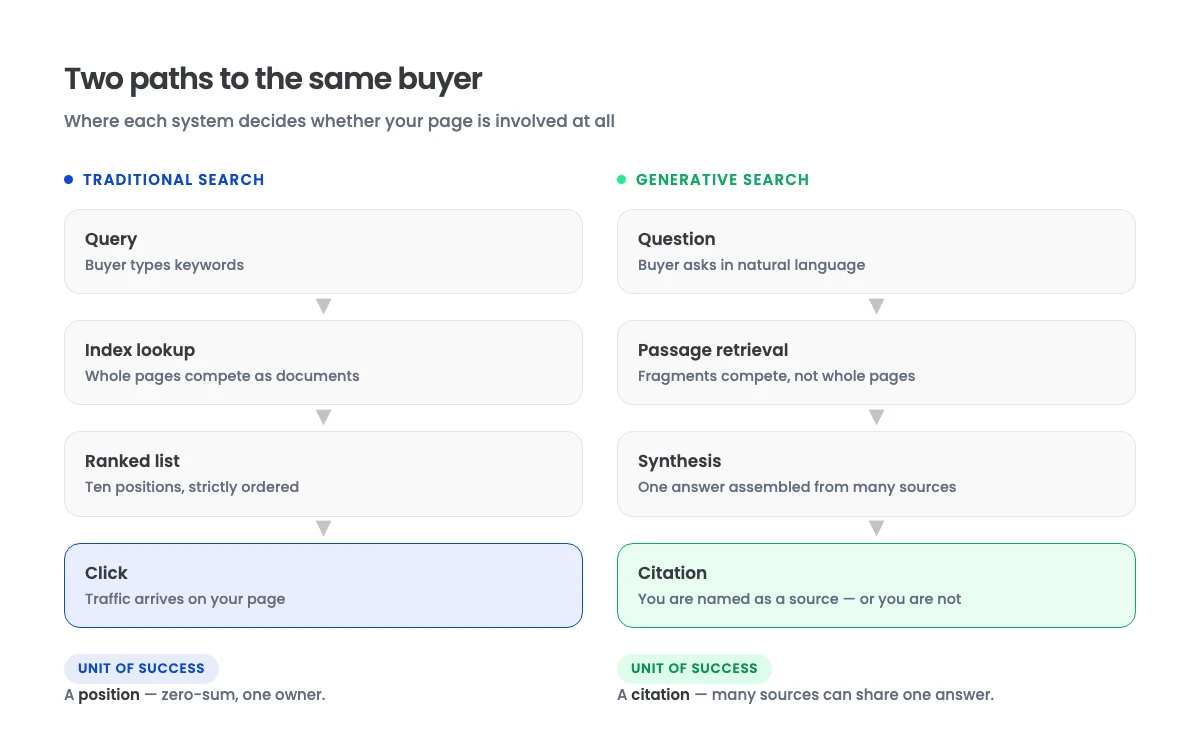
That difference in the unit of success is the root cause of every real distinction between the two disciplines. Everything else follows from it.
The Retrieval Path Is Different
In classic search, the engine has an index of your pages and a ranking function. Your page competes as a whole document against other whole documents.
In generative search, the system retrieves passages, not pages. A model assembling an answer about, say, sauna heater sizing pulls the specific paragraph that answers the sizing question, potentially from page 4 of a document that would never rank in the top ten as a whole. It then combines that passage with passages from other sources.
The practical consequence is that a mediocre page containing one exceptionally clear, self-contained, well-attributed paragraph can earn citations that its overall authority would never earn it in a ranked list. And a strong page whose key claims are buried in unstructured prose can be passed over entirely.
The Competitive Set Is Different
Ranking is zero-sum in a way that citation is not. Position 3 is position 3, and someone else cannot also have it. But a synthesized answer routinely cites five, eight, or a dozen sources, and it does not rank them in a way the user perceives as a hierarchy.
This changes the strategic math for smaller brands. Competing for a top-three organic position against a domain with fifteen years of authority is often not a rational use of budget. Being one of eight cited sources in an answer about your specific product category is a materially easier target, and the traffic that does arrive tends to be further down the funnel.
The Three Things That Genuinely Differ
If you only change three things about how you work, change these.
1. Write in Extractable Units
Content built for ranking is built to hold attention across a page. Content built for citation is built to be liftable in fragments.
That means a claim and its support live in the same paragraph rather than being developed across three. It means definitions are stated plainly and early rather than being led up to. It means comparison data sits in an actual table rather than being narrated. It means each section heading is a question a buyer would really ask, and the paragraph immediately beneath it answers that question completely, without requiring the reader to have read the previous section.
This is not a style downgrade. Writing that survives extraction tends to be clearer writing. But it is a real change to how a brief gets structured, and it is the single highest-leverage adjustment most content teams can make.
2. Be Consistent About Facts Across Your Whole Footprint
Ranking systems tolerate inconsistency. If your product page says one thing about shipping timelines and your FAQ says another, Google will still rank both.
Generative systems handle contradiction differently. When a model encounters conflicting claims about the same entity, it tends to either hedge, defer to whichever source it treats as more authoritative, or drop the claim entirely. Your own inconsistency becomes a reason not to cite you.
This makes claim hygiene a technical discipline rather than a copywriting nicety. Specifications, pricing structure, service areas, guarantees, and company facts need to agree across your site, your Merchant Center feed, your review profiles, and your third-party listings. Auditing for that consistency is real work that classic SEO never required.
3. Measure Presence, Not Position
You cannot rank-track a citation. Position tracking tells you nothing about whether a model mentions you when a buyer asks a category question.
The measurement stack for GEO is prompt-based: you define the set of questions your buyers actually ask, you run those prompts across the assistants your market uses, and you record whether you appear, in what context, and alongside which competitors. That gives you a share-of-voice figure that behaves nothing like a keyword ranking report and needs to be read differently.
If you want the tooling landscape for this, we covered it in the guide to AI search visibility tools.
The Four Things That Do Not Differ At All
This is where most GEO marketing gets dishonest. These are sold as new and are not.
Technical crawlability. A model cannot cite a page it cannot fetch. Render-blocking, broken canonicals, orphaned pages, and slow servers hurt generative visibility for exactly the same reason and through exactly the same mechanism that they hurt rankings. This is ordinary technical SEO, unchanged.
Structured data. Product, FAQ, Organization, and Article schema were valuable before AI search and are valuable now. The schema types have not changed. The reason to implement them has broadened.
Topical depth. Systems that assemble answers favor sources that demonstrate genuine coverage of a subject rather than one isolated page. Building out a real topic cluster was the right strategy in 2019 and remains the right strategy, for a slightly different reason.
Earned authority. Models weight sources partly by the signals that also drive traditional authority, including who links to you and how you are referenced elsewhere. Nobody has found a shortcut around this. Editorial link acquisition still does the same job.
If an agency tells you GEO requires abandoning these, they are describing a product, not a discipline.
How the Two Interact in Practice
The relationship is not competitive. In most categories, the pages that get cited in AI answers are drawn heavily from pages that already rank well, because the retrieval layer for these systems leans on conventional relevance and authority signals to decide what to read in the first place.
That gives you a useful sequencing rule: you cannot GEO your way out of a weak organic foundation. If your category pages do not rank and your site has no topical authority, there is no separate lever that makes a model cite you. The order of operations is to fix the foundation, then add the extraction and consistency work on top of it.
The inverse is also true and more encouraging. If you already have organic strength, capturing generative visibility is frequently a matter of restructuring existing content rather than producing new content. A page that ranks page one but is written as continuous narrative can often be made citable with a structural editing pass, not a rewrite.
A Realistic Sequence
For a brand starting from a reasonable organic position, the work usually orders like this:
- Audit claim consistency across the site, feed, and third-party profiles. Resolve contradictions. This is cheap and unblocks everything else.
- Restructure your highest-value existing pages into extractable units. Start with the pages already earning impressions, not new ones.
- Establish prompt-based measurement so you have a baseline before you change more. Without this you cannot tell whether anything worked.
- Fill genuine topical gaps with new content, built extractable from the first draft.
- Continue earning authority, because the retrieval layer still uses it.
Note that steps one through three cost far less than a content program and typically move the needle first. Most brands invert this and start by commissioning twenty new articles.
Where This Leaves Your Budget
The reason the “separate discipline, separate budget” framing is worth resisting is that it leads to duplicated spend on the 80% overlap and underinvestment in the 20% that is actually different.
A more accurate way to budget: keep your organic program roughly as it is, and add a specific line for claim consistency auditing, structural editing of existing high-value pages, and prompt-based measurement. That addition is usually a modest fraction of an existing retainer, not a second retainer.
The brands that are winning generative visibility right now are not the ones who bought a separate GEO product. They are the ones who had a solid organic foundation and made a deliberate, relatively small set of changes on top of it.
That is the whole thesis. The discipline is not new. The output format changed, three things follow from that change, and the rest is work you should have been doing anyway.
If you want to know where your brand currently stands in AI-generated answers, and what the gap between your organic position and your citation rate actually looks like, that is exactly what our AI search optimization engagements start with.
Ready to own your organic growth? Book a free strategy call and we will show you what is possible for your brand.