AI Search Monitoring: Turning One-Off Checks Into a Trend You Can Act On
A one-off AI visibility check is a snapshot. Monitoring is the discipline that turns it into a trend — what cadence to run, which changes are real, and how to tell a genuine drop from ordinary variance.
Entities in this article
Checking your AI visibility once tells you where you stand. Monitoring tells you whether anything you did worked — and that is a harder problem than it looks, because the underlying numbers are noisy enough to manufacture convincing stories in both directions.
A presence rate that moves from 34% to 41% might be your content work landing. It might also be nothing at all. Teams that cannot tell the difference end up either abandoning work that was succeeding or doubling down on work that did nothing.
This is about building a monitoring practice that survives that problem.
The Core Difficulty: Variance Is Large
Run the same prompt set twice on the same afternoon, changing nothing, and your presence rate will differ. Not by a rounding error — by several percentage points.
Three sources:
Model non-determinism. These systems sample from a distribution. Identical inputs produce different outputs by design.
Retrieval variation. Assistants that search live get different results at different moments, and a source that ranked fourth this morning may rank ninth this afternoon.
Silent model updates. Providers ship changes without announcement. A step change in your numbers on a specific date, across every prompt at once, is usually the platform, not you.
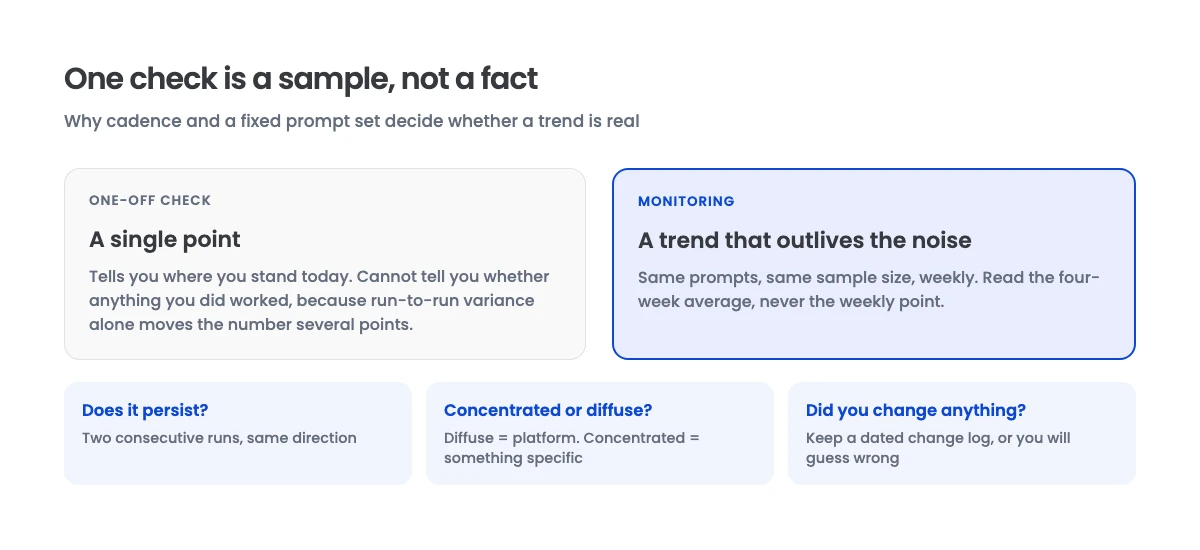
The practical consequence: any single measurement is a sample, not a fact. Monitoring is the discipline of taking enough samples that the trend outlives the noise.
Cadence: Weekly, Not Daily
Daily monitoring is almost always wrong for this metric. Day-to-day movement is dominated by variance, and watching it produces anxiety and false alarms rather than insight.
Weekly is the right default. It smooths run-level noise, matches the pace at which content work actually lands, and produces a series you can read after a quarter.
Monthly is defensible for smaller programmes where nothing changes weekly anyway.
The rule that matters more than the interval: keep the prompt set and sample size fixed between runs. A trend built on a prompt set that quietly changed is not a trend. If you must add prompts — and you should, quarterly — record the change date and treat it as a series break rather than pretending the line is continuous.
What to Track Over Time
Presence rate — the headline. Watch the four-week moving average, not the weekly point.
Share of voice — more stable than presence rate and often more informative. If your presence fell but share of voice held, the whole category moved and you did not lose ground.
Citation rate — moves later than presence and is the better leading indicator of traffic.
Prompt-level presence — the actionable layer. Aggregate rates hide the thing you can act on: a specific high-value prompt you fell out of. A 3-point aggregate drop concentrated entirely in your two most commercial prompts is a much more urgent event than the same drop spread evenly.
Competitor entries and exits — a new name appearing across several prompts at once usually means somebody published something good. Go and read it.
Telling a Real Change From Noise
Three tests before treating a movement as real.
Does it persist? A change visible in one week’s run and gone the next was variance. Two consecutive runs in the same direction is the minimum bar.
Is it concentrated or diffuse? A drop spread thinly across every prompt usually means a model update. A drop concentrated in a handful of related prompts usually means something specific — a page that changed, a competitor that published, a source that stopped being cited.
Did anything change on your side? Keep a simple change log — publishes, restructures, technical work, with dates. Without it you are reduced to guessing which of five things caused the movement, and you will guess wrong.
Add competitor movement as a control. If everyone dropped, it was the platform.
What Monitoring Cannot Tell You
Worth stating plainly, because monitoring dashboards invite over-reading.
It cannot attribute revenue. Assistants frequently strip referrer data. You will not get a clean line from presence rate to pipeline, and any vendor implying otherwise is overselling.
It cannot explain a change. It tells you that something moved. Diagnosis is manual: read the actual answers, see who replaced you, go and look at their page.
It is not comparable across tools. Different prompt sets, different models, different mention-matching. Switching tools resets your history — treat the choice as semi-permanent.
It does not cover models with fixed training data. Some answers come from parameters with no live retrieval. Nothing you publish this month affects those until the next model update, and no amount of monitoring changes that.
A Practical Setup
For a brand doing this seriously without over-investing:
- 40–60 prompts, weighted toward vendor-selection questions, refreshed quarterly.
- 5 runs per prompt, weekly, in clean sessions.
- Two or three assistants — the ones your buyers actually use, not all of them.
- Four to six competitors tracked on the identical set.
- A change log kept alongside, with dates.
- A monthly read, not a weekly panic. Look at the four-week average, the prompt-level detail, and the competitor set together.
That is roughly 600–900 queries a week — beyond what a person should do by hand, which is the honest argument for tooling. We assessed the main options in the guide to AI search visibility tools.
If you have not yet established a baseline, start with how to run an AI visibility check — monitoring a set of prompts you have not validated is an expensive way to track the wrong questions. And for what the metrics mean and which you can influence, see AI visibility.
The Thing Most Programmes Get Wrong
They monitor faithfully and act on none of it.
A monitoring setup earns its cost only if a prompt-level drop triggers something: someone reads the answers, identifies who replaced you, and decides whether to respond. Without that loop it is an expensive way to feel informed.
Set the trigger explicitly. Something like: any prompt in the commercial tier that loses presence for two consecutive weeks gets a human read within five working days. That single rule turns a dashboard into a process.
If you want monitoring set up and, more usefully, someone reading it — the diagnosis, not just the graph — that is part of how our AI search optimization engagements run. Book a free strategy call and we will show you what your current trend looks like.